
Private Residence Bug Sweeping
Discreet TSCM sweeps of private homes, apartments, home offices and estates for principals, family offices and private clients in London and every EU capital.
Please contact us from outside any space you believe may be compromised.
When a home needs a sweep
A residential bug sweep is a TSCM inspection of a private home for listening devices, hidden cameras, line taps and trackers. Homes are where the most personal conversations happen, and more and more of them are also where business is done.
Unlike an office, a home is usually targeted by someone with access: household staff, contractors, visitors, or someone close to the family. Common reasons to sweep a residence are matrimonial or family disputes, inheritance and succession, high-profile litigation, building or renovation works, a change of household staff, a break-in where nothing was taken, and private matters becoming known to people who should not know them.
We plan residential work around the household and carry it out discreetly. In personal matters we advise on involving your lawyers before anything found is touched, because how a device is handled can decide whether it can be used later. If you have already found something, read what to do first.
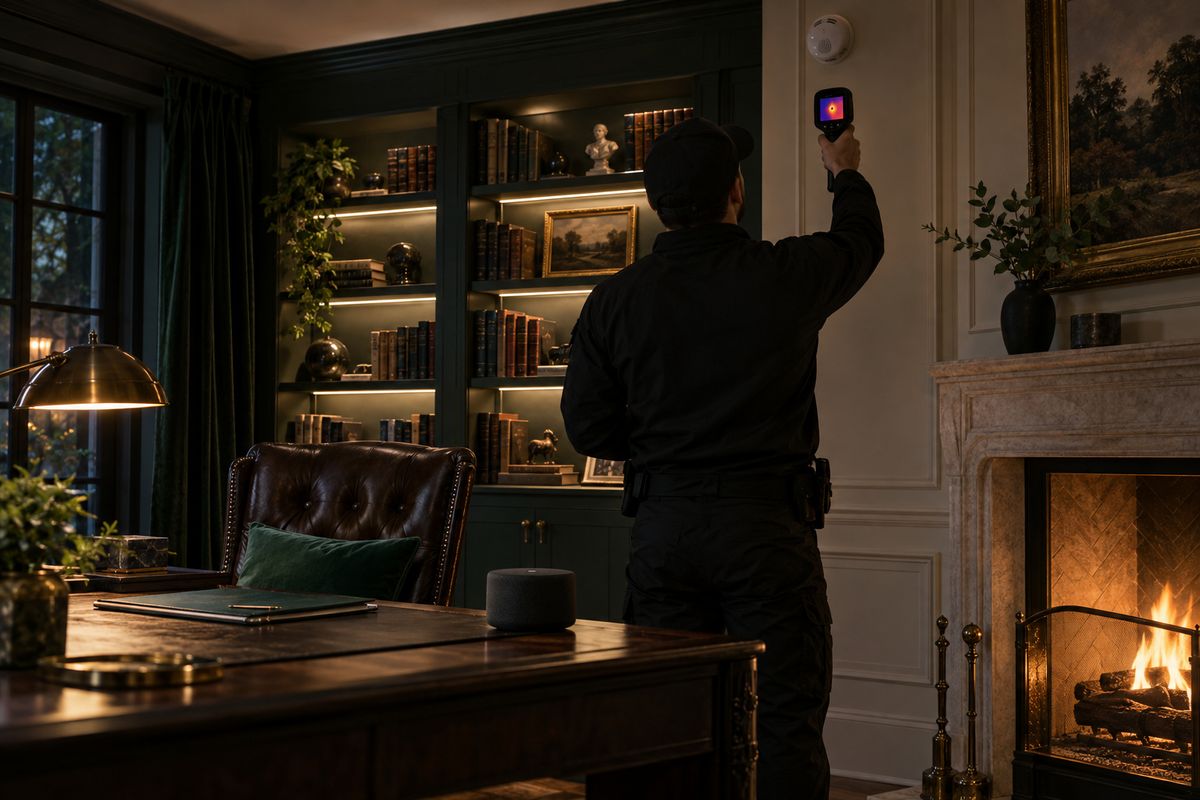
What we look for in a home
Audio devices
Microphones and recorders in furniture, lamps, gifts and household items, often placed by someone with regular access.
Hidden cameras
Covert cameras in smoke detectors, clocks, chargers and picture frames in living areas, studies and bedrooms.
Telephone & broadband lines
Landlines, broadband connection points and cabling altered to tap calls or carry audio out of the house.
Wireless devices
Rogue access points and hidden Wi-Fi or Bluetooth devices placed in or near the home to capture audio or data.
Household vehicles
GPS trackers on family vehicles, which are often the first device placed in a domestic or family dispute.
Staff & contractor areas
Staff rooms, garages, outbuildings and plant rooms, where a device can be placed or serviced without being seen.
What a residential sweep covers
- Living rooms, studies and home offices, dining rooms and bedrooms
- Furniture, lamps, artwork, gifts and recently arrived items
- Smoke detectors, clocks, chargers and anything plugged in
- Rogue access points and hidden Wi-Fi or Bluetooth devices
- Telephone lines and the broadband connection point
- Staff areas, garages, outbuildings and plant rooms
- Household vehicles, on request
- The radio-frequency environment of the property
Every sweep layers RF spectrum analysis (10 kHz–24 GHz), non-linear junction detection, thermal imaging, telephone and line testing, Wi-Fi and lens detection, and a physical search. See our method for how each technique works.
How a residential sweep works
Contact us from a phone and network outside the property. We agree the scope and timing on a confidential call, under an NDA if you wish.
We schedule the sweep when the home is quiet and keep the number of people who know about it, including staff, to a minimum.
RF spectrum analysis, non-linear junction detection, thermal imaging and a careful physical search, respecting the home and its contents.
Anything found is photographed and documented in place, and nothing is removed until you have spoken to your lawyers.
A private debrief, then a written report suitable for your lawyers, insurers or family office, with recommendations.
Do not search the house yourself first. Moving furniture or unplugging devices can alert whoever placed them and damage evidence. If you suspect something, behave normally, contact us from outside the home, and read what to do if you find a device.
Who carries out the work
Our technical leadership includes Mike Moran, whose biography describes more than 25 years of intelligence, surveillance and counter-surveillance experience, and Paul Chauveau, an REI and cellular systems specialist. Read their professional backgrounds. The proposed inspection team, relevant qualifications and scope are confirmed for each assignment.

Timing, duration and cost
An apartment or townhouse usually takes one team-day for a two-person team. A large residence, an estate with outbuildings, or a home combined with several vehicles can take two to three days.
Travel and expenses are charged in addition, and every engagement is confirmed with a fixed written quotation. For what drives the price, read how much a bug sweep costs.
Frequently asked questions
Why would someone bug a private home?
The most common reasons are family and matrimonial disputes, inheritance and succession, litigation, business conflicts and the profile of the people living there. Devices are usually placed by someone with access to the home rather than by a stranger.
Do we need to prepare the house for the sweep?
No. We work with the home as it is normally lived in, with furniture and belongings in place. Please do not tidy or rearrange rooms beforehand, because that can disturb what we are looking for.
Will household staff know about the sweep?
Only if you choose. Many residential sweeps are scheduled when staff are off duty, and we keep the number of people who know about it to a minimum.
How long does a home sweep take?
An apartment or townhouse usually takes one team-day for a two-person team. Large residences and estates with outbuildings take two to three days.
Can the report be used in a legal dispute?
The written report records what was inspected, the methods used and any findings with photographs and locations, so that it can support your lawyers. Whether and how it is used is a decision for you and your legal advisers.
Can you also check our cars?
Yes. Vehicle checks for GPS trackers and audio devices are often combined with a residential sweep on the same visit.
Confidential Consultation
NDA on request. Answered personally — no call centres.