
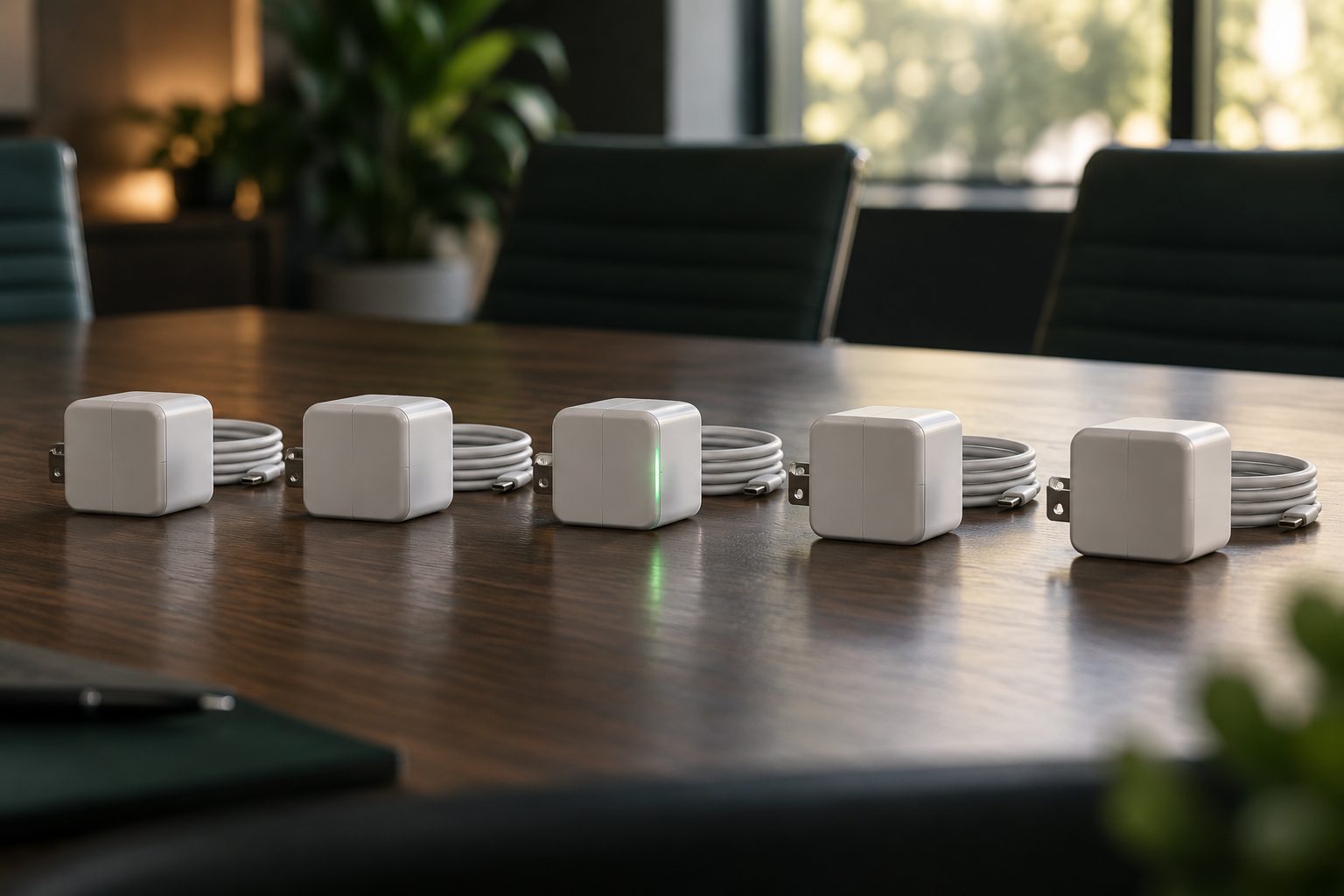
Team experience: this article draws on concealment types encountered by members of our team during their professional careers. The example is explained in general terms for confidentiality and is not presented as a Bureau Securitas Ltd. client engagement.
An ordinary-looking charger can raise a difficult inspection question: does the object contain only its expected charging electronics, or has it been altered? Normal charging operation cannot answer that question on its own.
For a concern in a meeting room, our office and boardroom TSCM service considers the object within the wider inspection scope. The room’s access and equipment history can be as useful to the brief as the object’s appearance.
The example and its limits
In this type of concealment, an everyday powered object is the housing for an additional function, such as recording or transmitting sound. The particular components, power arrangements and communications depend on the device. This article does not attach a universal price, battery life or capability to every modified charger.
A warm adapter, an unfamiliar label or an object somebody does not recognise is a reason to identify it, rather than proof of a listening device. Legitimate chargers vary in design and temperature during use.
Establish the equipment history
Ask who supplied the charger, whether it belongs to the organisation or property operator, and when it entered the room. Compare the inventory and service records. If an authorised examination needs an appropriate reference unit, confirm the exact model rather than comparing unrelated chargers.
The Australian Cyber Security Centre’s travel guidance recommends trusted peripherals and caution with unfamiliar chargers and cables. That supports a sensible equipment policy; it does not establish that a particular charger is malicious.
Why a detector reading is not the conclusion
REI’s NLJD explanation describes detecting electronic components independently of an active transmission. A legitimate charger already contains electronics, so an indication alone cannot distinguish normal circuitry from an added device.
An electronic observation must be considered alongside physical inspection, device identification and the agreed authority to examine the item. Testing connected accounts, extracting recordings or examining a laptop is separate from an ordinary premises sweep.
Where the concern is a compromised computer or digital evidence, discuss digital forensic support. The appropriate response depends on what information is available and what access is authorised.
Avoid opening a mains-powered object
Do not open or modify a charger yourself. Electrical safety and potential evidence both need consideration. If a suspicious object has been found, seek appropriate instructions and read what to do after a discovery. Personal safety takes priority over preserving an unchanged scene.
The examination report should state what was inspected, what was identified and any remaining uncertainty. It should not promise that a single equipment check establishes the absence of all surveillance in a room.
Frequently asked questions
Does normal charging prove the charger is safe?
It establishes that the charging function works. It does not independently establish the complete contents or behaviour of the object.
Does an NLJD prove that extra electronics were added?
No. Legitimate chargers contain electronics. Identification requires interpretation and appropriate further examination.
Will a USB data blocker prevent audio recording?
A device that restricts USB data transfer addresses that connection. It does not establish whether an object separately records sound or communicates another way.
Arrange an appropriate scope
Discuss the room and equipment concern, including who owns the object, who controls access and what was observed. If the item is in a hotel, the hotel-room inspection guide explains the additional permission questions.
Sources and editorial notes
- Australian Cyber Security Centre: security tips for travelling — trusted peripherals and device precautions.
- REI: non-linear junction detection — electronic detection principles.
The concealment example draws on team career experience. Inspection and commissioning recommendations are our editorial guidance. Sources reviewed 26 October 2026.