Hotel Suite & Meeting Room Bug Sweeping
Pre-arrival TSCM sweeps of hotel suites, adjoining rooms and hotel meeting rooms for executives, principals and delegations travelling to London and every EU capital.
Please contact us from outside any space you believe may be compromised.
Why hotel suites need a sweep
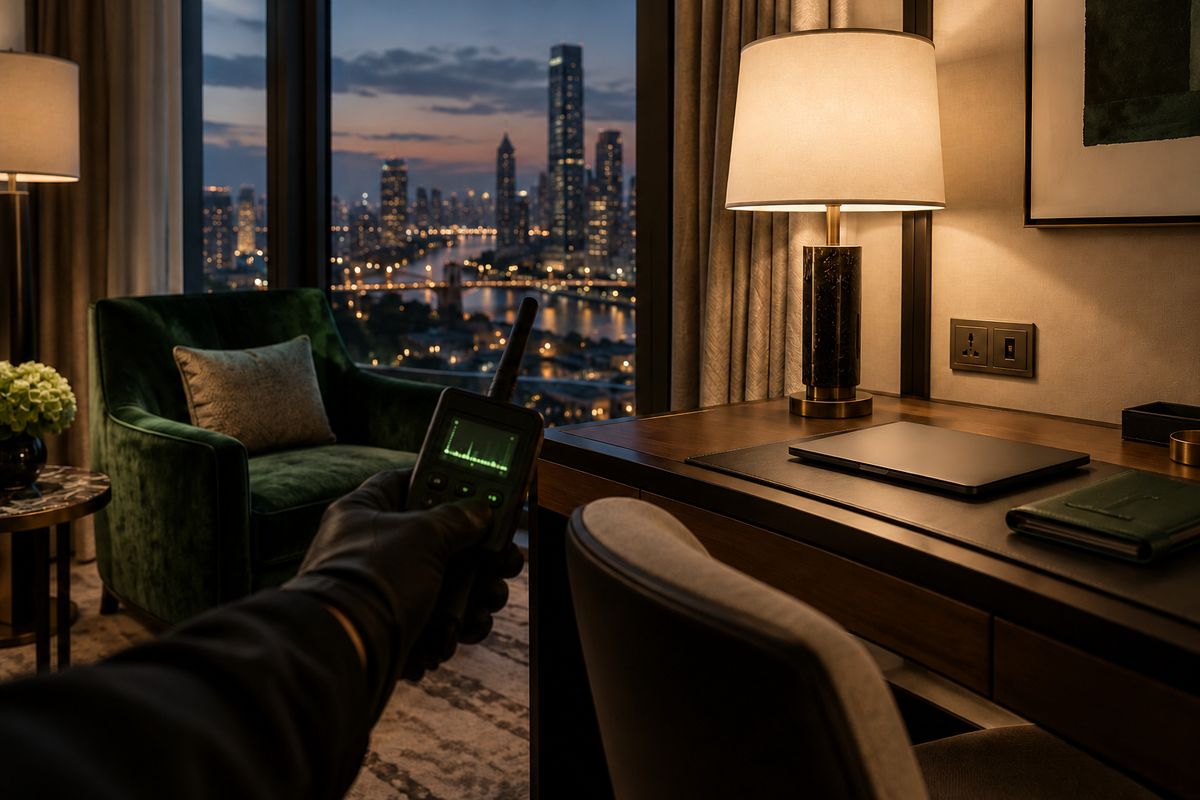
A hotel room bug sweep is a TSCM inspection of a suite after it has been allocated and before the guest arrives. Senior travellers take private calls in their suite, review papers there, hold side meetings in the sitting room and leave devices and documents in the room overnight.
A hotel suite is also a room that many other people can enter: housekeeping, maintenance, room service, previous guests, and anyone who obtains a key. The booking often makes the room and the dates known in advance. A device can be placed before arrival and collected after departure, with no trace left for the guest to notice.
A pre-arrival sweep confirms the suite is clear when the principal checks in. Combined with simple access controls for the rest of the stay, it keeps it that way. For the full picture of how this works on executive trips, read our guide to hotel room bug sweeps for executives.
What we look for in a hotel suite
Audio devices in furnishings
Microphones in lamps, headboards, sofas, desks and minibar units, where they can stay hidden for the length of a stay.
Hidden cameras
Covert cameras in smoke detectors, clocks, TVs, air vents and decorative items, aimed at the desk, the bed or the sitting area.
Planted chargers & adapters
USB chargers, adapters and power strips left in the room that look like hotel supplies but contain a microphone and SIM.
Cellular & call-activated bugs
Devices that transmit over the mobile network, or stay silent until called, so a quick scan can miss them.
Hotel Wi-Fi & rogue networks
Fake access points and devices on the hotel network used to intercept traffic from guests' laptops and phones.
Meeting rooms & adjoining rooms
Hotel meeting rooms, connecting doors and adjoining rooms that can be used to listen in on the suite.
What a hotel sweep covers
- Every room of the suite: sitting areas, bedroom, study, dressing room and bathroom
- Lamps, TVs, clocks, smoke detectors, air vents and minibar units
- Furniture, headboards, desks and soft furnishings
- Power sockets, chargers and anything left plugged in
- Room telephones and in-room entertainment systems
- The suite's radio-frequency environment and the wireless networks around it
- Connecting doors and, where access allows, adjoining rooms
- Hotel meeting rooms or private dining rooms used during the stay
Every sweep layers RF spectrum analysis (10 kHz–24 GHz), non-linear junction detection, thermal imaging, telephone and line testing, Wi-Fi and lens detection, and a physical search. See our method for how each technique works.
How a pre-arrival hotel sweep works
We agree the hotel, the suite and the timing with your security or travel team. Access is arranged through the booking, with as few hotel staff involved as possible.
The sweep takes place after the suite has been allocated and before the principal arrives, so the room we inspect is the room that is used.
RF spectrum analysis, non-linear junction detection, thermal imaging and a methodical physical search of every room in the suite.
We confirm the suite is clear and advise on keeping it that way: do-not-disturb, controlled housekeeping, and how to handle papers and devices.
For longer stays or high-risk visits, we re-check the suite after housekeeping or before key meetings, and sweep meeting rooms on the day.
Changing rooms is not a fix. Switching rooms at check-in can avoid a device placed in advance in one suite, but it does nothing about the hotel Wi-Fi, the chargers in the room or a device brought in later. A sweep confirms the room you actually use.
Who carries out the work
Our technical leadership includes Mike Moran, whose biography describes more than 25 years of intelligence, surveillance and counter-surveillance experience, and Paul Chauveau, an REI and cellular systems specialist. Read their professional backgrounds. The proposed inspection team, relevant qualifications and scope are confirmed for each assignment.
Timing, duration and cost
A hotel suite usually takes two to four hours for a two-person team, depending on its size and the equipment in it. Because the team is booked by the day, a hotel sweep is commonly combined with the meeting room, the vehicle and any other location used on the same day.
Travel and expenses are charged in addition, and every engagement is confirmed with a fixed written quotation. For what drives the price, read how much a bug sweep costs.
Frequently asked questions
When should a hotel suite be swept?
After the suite has been allocated and before the principal arrives, ideally on the day of arrival. For longer stays, a re-check after housekeeping or before important meetings in the suite keeps the assurance current.
Does the hotel need to know about the sweep?
The hotel needs to give access, but it does not need to know the reason. Access is usually arranged through the booking, and as few hotel staff as possible are involved.
How long does a hotel room sweep take?
Two to four hours for a typical suite with a two-person team. A very large suite, or several rooms for a delegation, can take most of a day.
Can you sweep a hotel meeting room as well?
Yes. Hotel meeting rooms and private dining rooms are swept on the day they are used, as close as practical to the start of the meeting, and can be combined with the suite in the same team-day.
Is hotel Wi-Fi safe for confidential work?
Treat it as untrusted. We check for rogue access points around the suite, but the safest practice is to use your own mobile connection or a VPN and to keep sensitive devices off the hotel network altogether.
Can you cover a delegation staying in several rooms?
Yes. For delegations we plan the sweep across the rooms, meeting spaces and vehicles in use, and size the team and days to fit the arrival schedule.
Confidential Consultation
NDA on request. Answered personally — no call centres.