
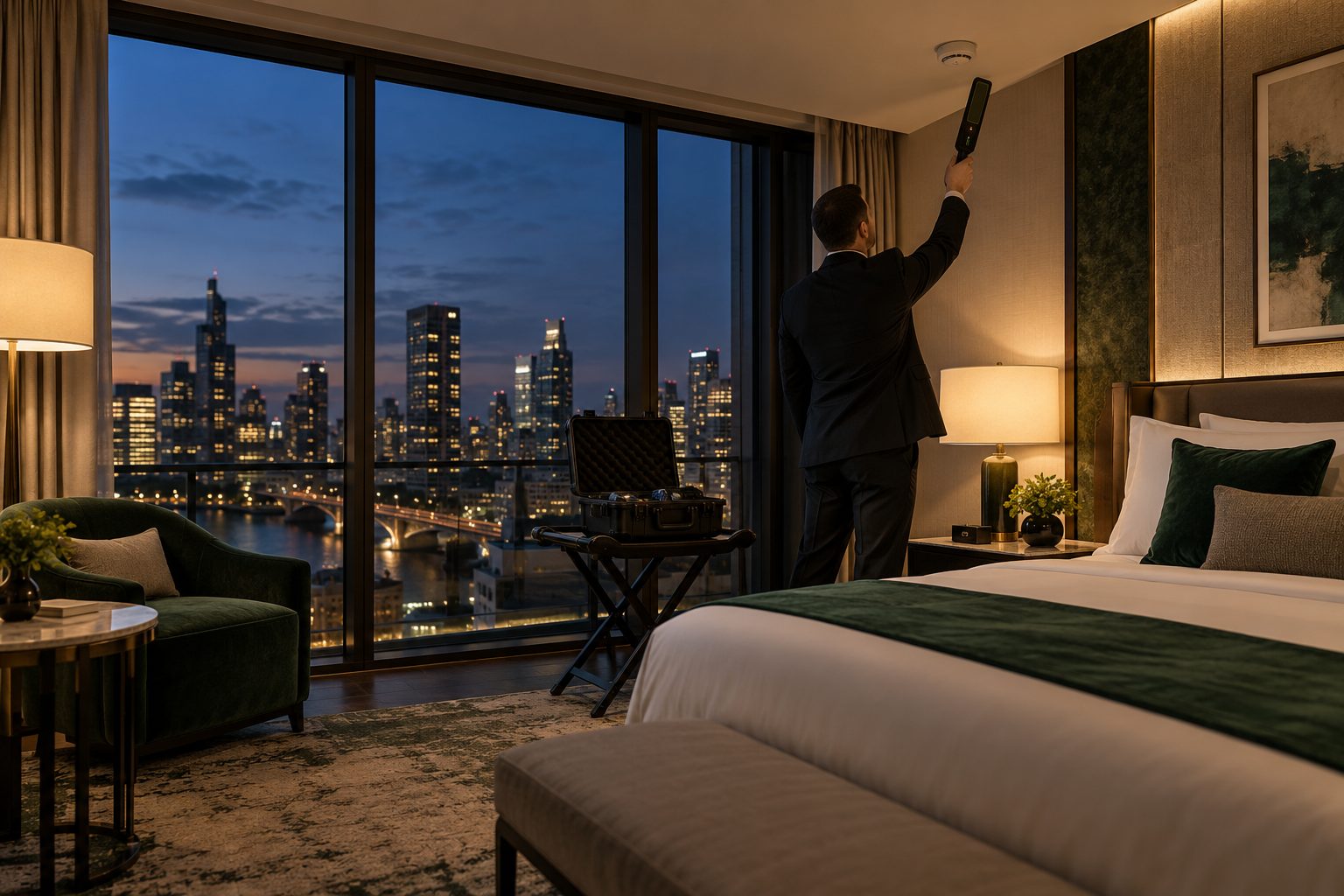
For a sensitive hotel stay, plan around the actual suite, meeting room and access window. A quick look around can reveal something worth reporting, but a phone torch, app or Wi-Fi list cannot establish that a room is free of surveillance.
Our hotel-room and private-meeting TSCM service starts with room allocation, the operator’s permission and the time before sensitive use. Hotel meeting rooms and vehicles need their own agreed scope.
Start before the travel date
Ask the travel organiser or authorised security contact to confirm:
- The property and the spaces that need examination.
- When each room will be allocated and made available.
- Who at the property can authorise access and permitted inspection methods.
- When furniture, AV systems or other equipment will be installed.
- Who controls entry after the inspection and before the meeting or arrival.
- What the plan is if the hotel substitutes another room.
A booking does not automatically authorise opening fixtures, handling hotel equipment or testing shared systems. Permissions and operator restrictions should be settled before the team travels.
What a guest can observe
The US State Department’s lodging guidance includes checking for unusual electronics and reporting concerns to the front desk. Treat an observation as a reason to ask questions, rather than a diagnosis.
You can note unfamiliar objects, obvious damage or equipment that differs from what the hotel describes. Do not open chargers, dismantle smoke detectors, interfere with fire systems or access other guests’ networks. A reflection, LED, warm adapter or unfamiliar wireless name can have an ordinary explanation.
If you find a suspected device, move to a safe location and follow our discovery and reporting guide. Seek immediate police help if anyone is at risk; do not delay a safety response for a sweep.
Agree what the professional inspection includes
The proposal should identify the rooms, accessible areas, methods and restrictions. Electronic survey work and physical examination should be selected for the concern. Any examination of phones, laptops or hotel networks needs separate authority and scope.
REI’s description of non-linear junction detection explains how electronics may be indicated without an active transmission. In a room full of legitimate electronics, an indication needs interpretation and further examination.
Afterwards, ask for a handover explaining the findings, inaccessible areas and limits. An inspection records conditions at the time of the visit. Agree how later housekeeping, maintenance or equipment changes will be managed.
Protect devices and conversations throughout the trip
New Zealand’s business-travel security guidance emphasises keeping control of information and devices, including in hotels. Build those precautions into the itinerary alongside any room inspection.
Use organisation-approved communications and travel devices. Avoid leaving confidential material unattended. A trusted connection can protect network traffic in appropriate circumstances, but it does not prevent a nearby microphone from capturing a spoken conversation. Choose an authorised private space for sensitive discussions; moving outdoors is not automatically a secure alternative.
For travel involving a principal, a meeting itinerary or several venues, discuss protective intelligence separately from the room inspection. The wider brief may concern routes, exposure and the information needed for planning.
Frequently asked questions
Can a guest inspection prove a suite is clear?
No. Observations can identify concerns, but they do not establish the absence of surveillance. Professional methods also have scope and access limitations.
Will the hotel need to be involved?
The relevant property controller must authorise the work and agree access. Discretion does not remove that requirement.
Can you guarantee completion before arrival?
Timing is confirmed after room allocation, scope, permissions and team availability are known. Tell us the actual deadline early.
Arrange the visit
Discuss a pre-arrival inspection with the city, travel dates, room allocation and meeting timetable. Our London-stationed team deploys by arrangement. See pricing and quotation factors before comparing proposals.
Sources and editorial notes
- US State Department: lodging safety — guest observations and reporting.
- New Zealand Protective Security Requirements: business travel — information and device handling during travel.
- REI: non-linear junction detection — technical background.
Inspection planning recommendations are Bureau Securitas editorial guidance. Sources reviewed 26 October 2026.