
Office & Boardroom Bug Sweeping
Discreet TSCM sweeps of boardrooms, executive offices and meeting rooms in London and every EU capital. We find listening devices, hidden cameras, compromised lines and rogue wireless equipment, and document anything we find so that it can be used.
Please contact us from outside any space you believe may be compromised.
Why boardrooms are the first target
A boardroom bug sweep is a TSCM inspection of the rooms where an organisation's most valuable conversations happen. Strategy, transactions, results, litigation and personnel decisions are discussed in a small number of rooms, at times that are often known in advance. That makes them the most efficient place to put a device.
Offices are also easy to access. Cleaners, contractors, AV technicians, couriers, visitors and former staff all pass through, and new furniture, chargers and equipment arrive every week. A device does not need to be sophisticated: a microphone in a power adapter or a docking station can run for months unnoticed, as our docking-station case study shows.
Our office sweeps cover the boardroom, executive offices, PA areas and any meeting rooms used for sensitive business, together with the telephone, AV and network equipment that serves them. If you are not sure whether you need one, start with 12 signs your office may be bugged.
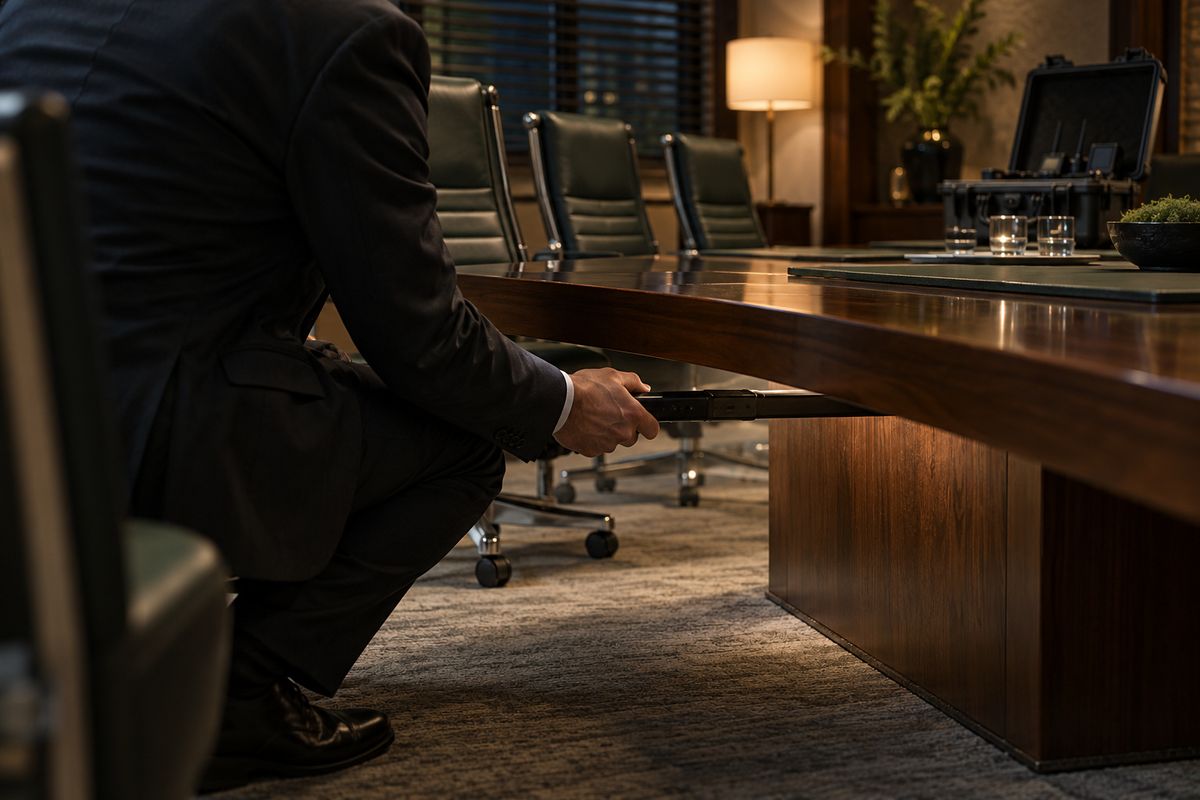
What we look for in an office
Audio transmitters & recorders
Pin-sized microphones in furniture, fittings and equipment, either transmitting or recording locally for later collection.
GSM / cellular bugs
Devices with a SIM card that send audio over the mobile network, or stay silent until someone calls them.
Compromised everyday items
Chargers, power strips, docking stations and adapters with a hidden microphone, powered by the socket indefinitely.
Hidden cameras
Covert cameras in smoke detectors, clocks, AV equipment and ceiling fittings, often aimed at screens and whiteboards.
Telephone & AV systems
Desk phones, conference speakers and video-conferencing systems altered or configured to pass audio out of the room.
Network & wireless devices
Rogue access points, Wi-Fi and Bluetooth devices placed on or near the network to capture data or audio.
What an office sweep covers
- The boardroom table, chairs and credenzas, including undersides and internal cavities
- Ceiling voids, raised floors, floor boxes and cable trays
- Power sockets, chargers, extension leads and anything plugged in
- Desk telephones, conference phones, AV and video-conferencing equipment
- Smoke detectors, clocks, lighting, artwork and decorative items
- Telephone and data cabling, network points and patch areas serving the room
- The radio-frequency environment of the floor and adjoining rooms
- Executive offices, PA areas and breakout rooms used for sensitive discussions
Every sweep layers RF spectrum analysis (10 kHz–24 GHz), non-linear junction detection, thermal imaging, telephone and line testing, Wi-Fi and lens detection, and a physical search. See our method for how each technique works.
How an office sweep works
On a confidential call, under an NDA if you wish, we agree which rooms, floors and equipment are in scope, who knows about the sweep and when the space can be closed.
The sweep is usually carried out in the evening or at a weekend, so staff and visitors do not see it and the radio environment is quieter.
RF spectrum analysis, non-linear junction detection, thermal imaging, line testing and a methodical physical search of each room.
Anything found is photographed and documented in place. Nothing is removed until you have decided on next steps with your advisers.
A verbal debrief at the end of the sweep, then a written report recording what was inspected, how, and what was found.
Sweep the room once it is set up, not before. Furniture, AV equipment and catering that arrive after a sweep bring new risk, so we time the inspection as close to the meeting as practical and advise on keeping the room locked and controlled until it is used.
Who carries out the work
Our technical leadership includes Mike Moran, whose biography describes more than 25 years of intelligence, surveillance and counter-surveillance experience, and Paul Chauveau, an REI and cellular systems specialist. Read their professional backgrounds. The proposed inspection team, relevant qualifications and scope are confirmed for each assignment.
Timing, duration and cost
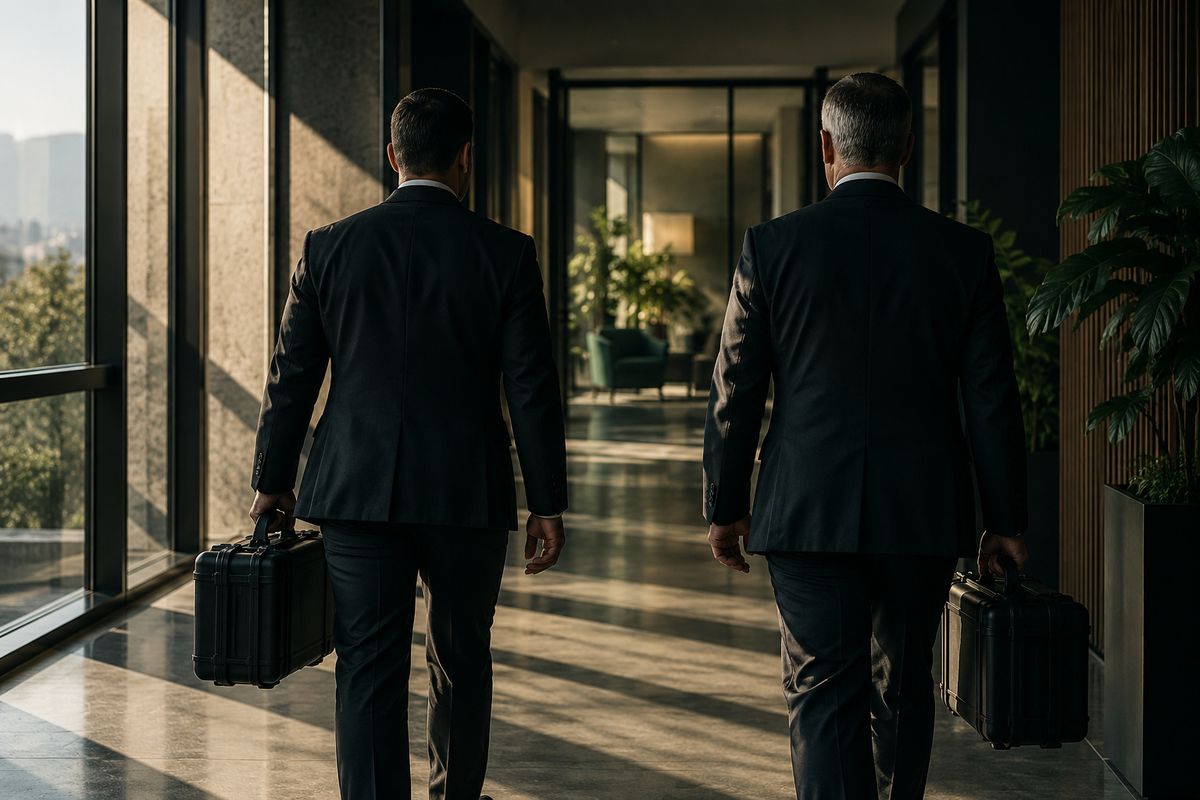
The most useful times to sweep an office are just before a sensitive meeting, after building works or an office move, after a security incident, and on a regular schedule for rooms used for board business. A two-person team typically covers a boardroom or executive office of about 100–200 m² in one team-day.
Travel and expenses are charged in addition, and every engagement is confirmed with a fixed written quotation. For what drives the price, read how much a bug sweep costs.
Frequently asked questions
How often should a boardroom be swept?
Rooms used for board meetings, transactions or other price-sensitive discussions are commonly swept quarterly, plus before specific high-value meetings and after any building work, office move or security incident. A regular schedule also gives you a documented baseline for each room.
Can you sweep the office without staff knowing?
Yes. Most office sweeps are carried out out of hours, and only the people you choose are told. The sweep should not be arranged by email or phone on the premises' own systems if you suspect they are compromised.
Do we need to clear the office before the sweep?
No. Rooms are swept as they are normally used, with furniture, equipment and papers in place. Please do not tidy or rearrange the room beforehand, because changes can hide what we are looking for.
Will you check our IT network?
We check telephone and data cabling, network points and the wireless environment for physical devices and rogue access points. A TSCM sweep is not a cyber-security audit of servers or software; if you need one, we can advise on scoping it separately.
How long does an office sweep take?
A boardroom or executive office of about 100–200 m² usually takes one team-day for a two-person team. A full executive floor or headquarters can take two to three days, depending on size and the amount of equipment in the rooms.
What happens if you find a device in our office?
We document it in place and preserve it as evidence. We advise on next steps, including legal advice and whether to involve the police, before anything is removed, and then check related rooms, because a second device is common.
Confidential Consultation
NDA on request. Answered personally — no call centres.