
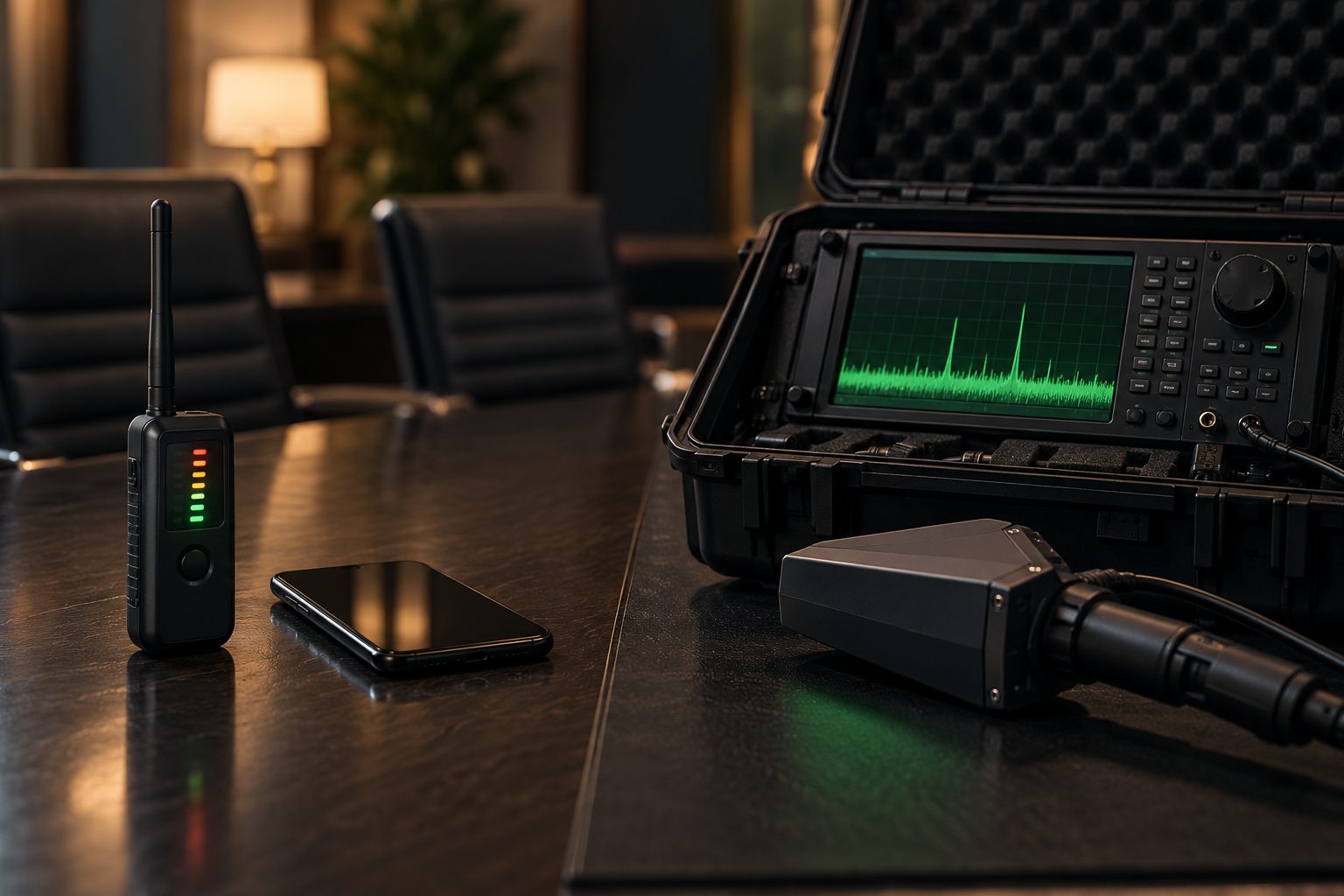
A handheld bug detector or RF detector can find some listening devices, but only while they are transmitting. It cannot find voice-activated recorders, devices that are switched off, or GSM bugs that stay silent until someone calls them, and in a normal office it is swamped by legitimate Wi-Fi and mobile signals. Phone "bug detector" apps are less capable still. They are useful as a basic screen, not as proof that a room is clear.
This guide explains how each type of detector works, what it can and cannot find, and when a professional sweep is the better choice.
Key facts
- RF detectors react to radio energy nearby; they find only devices that are transmitting at that moment
- Recorders transmit nothing, so no RF detector can find them
- GSM/4G bugs are often silent until called, so they pass a quick scan
- Hidden-camera lens finders work by spotting reflections and can find some cameras at close range
- Phone apps mostly use the phone's magnetometer or list Bluetooth and Wi-Fi devices; they are not RF detectors
- Professional sweeps add spectrum analysis, non-linear junction detection, thermal imaging and a physical search
How a handheld bug detector works
A typical handheld "bug detector" is a broadband RF detector. It has an aerial and a meter or LEDs that rise as you get closer to a source of radio energy. If a transmitting device is in the room and switched on, the reading increases as you approach it.
That is the theory. In practice, three things get in the way.
1. Most devices are not transmitting when you look
- Recorders store audio internally and transmit nothing.
- GSM and 4G bugs often stay silent until they are called, or wake only when they hear sound.
- Burst devices store audio and send it in short bursts, sometimes at night.
- Devices that are switched off remotely or on a timer show nothing at all.
A detector cannot find a signal that is not there.
2. Modern buildings are full of legitimate signals
Wi-Fi routers, mobile phones, Bluetooth headsets, smart meters, wireless presenters and building systems all emit radio energy. A sensitive detector reacts to all of them, so the operator has to tell a bug apart from the office printer. Without a spectrum analyser that shows what the signal is, this is guesswork.
3. Sensitivity and frequency range are limited
Low-cost detectors cover a limited frequency range and give no information about the signal beyond its strength. Some devices use frequencies or modulation that cheap units do not respond to well.
Hidden camera detectors
Hidden camera detectors usually work in one of two ways:
- Lens finders shine red LEDs through a viewer; a camera lens reflects the light back as a bright point. They can find cameras at close range, if you look from the right angle.
- RF mode works like a bug detector and finds wireless cameras only while they transmit.
Cameras that record to a memory card, or upload only occasionally, will not show up in RF mode. A careful lens search is more useful. For a step-by-step method, read how to detect hidden cameras.
Do bug detector apps work?
Mostly not. Phone apps marketed as "bug detectors" generally do one of three things:
- Use the phone's magnetometer to react to metal and magnets. That is a metal detector, not a bug detector.
- List nearby Bluetooth or Wi-Fi devices. This can be genuinely useful for spotting an unknown device on a network or a Bluetooth tracker, but it will not find a GSM bug or a recorder.
- Use the camera to spot infrared light from some night-vision cameras.
A phone cannot measure radio signals across the spectrum in the way a detector or spectrum analyser does. An app that claims to find "all bugs" is overselling.
What each tool can and cannot find
| Tool | Finds | Misses |
|---|---|---|
| Phone app | Some Bluetooth and Wi-Fi devices; some IR cameras | GSM bugs, recorders, RF transmitters, most cameras |
| Handheld RF detector | Devices transmitting at that moment, close by | Recorders, call-activated and switched-off devices; struggles with background signals |
| Lens finder | Some camera lenses at close range | Cameras behind tinted covers or out of line of sight; audio devices |
| Professional TSCM sweep | Transmitting and non-transmitting electronics, line taps, cameras | Very little, if the search is thorough and the team is qualified |
What a professional sweep adds
A professional TSCM team uses equipment and methods designed for exactly the cases above:
- Spectrum analysis from 10 kHz to 24 GHz, comparing the room against the local radio environment to pick out unusual and short-burst signals
- Non-linear junction detection (NLJD), which finds semiconductor electronics whether they are on, off or recording, and is how recorders and dormant devices are found
- Thermal imaging to spot heat from hidden electronics
- Telephone and line testing for taps and devices drawing power or data from cabling
- A methodical physical search, opening and comparing suspect items, because the human search finds what instruments miss
Just as important is experience: knowing where devices are placed, what legitimate signals look like, and how to document a find so that it can be used. Our method and our guide to what listening devices look like explain more.
When a detector is enough, and when it is not
A detector or app is reasonable as a quick personal check, for example before a private call in a hotel room, as long as you understand that a clean reading does not prove a room is clear.
It is not enough when the stakes are high: before transactions, board meetings and sensitive negotiations, during disputes or litigation, after a leak, or when hosting senior visitors. In those cases, a false sense of security is worse than none. A professional sweep in Europe typically costs €2,500–5,000 per team-day for planned work plus travel; see how much a bug sweep costs.
Bureau Securitas provides professional TSCM sweeps across London and every EU capital. Contact us from a safe device at tscm@bureausecuritas.com. NDA on request.
Frequently asked questions
Do bug detectors actually work?
Partly. A handheld bug detector can find a listening device that is transmitting nearby at the moment of the scan. It cannot find recorders, devices that are switched off, or GSM bugs that are silent until called, and it is easily confused by Wi-Fi and mobile signals.
Can an RF detector find a GSM bug?
Only while the bug is transmitting, for example during a call. Many GSM bugs stay silent until someone calls them, so a quick scan with an RF detector usually misses them.
Do bug detector apps on phones work?
Not as bug detectors. Most use the phone's magnetometer, which reacts to metal, or list nearby Bluetooth and Wi-Fi devices. A phone cannot scan radio frequencies the way a dedicated detector or spectrum analyser does.
Can a hidden camera detector find all cameras?
No. Lens finders can spot some camera lenses at close range if you look from the right angle, and RF mode only finds wireless cameras while they transmit. Cameras that record to a memory card can be missed.
What equipment do professionals use to find bugs?
Professional TSCM teams use spectrum analysers covering roughly 10 kHz to 24 GHz, non-linear junction detectors that find electronics even when switched off, thermal cameras, telephone and line analysers, and a methodical physical search.
Is it worth buying a bug detector?
For a quick personal check it can help, as long as you know its limits. For boardrooms, homes or vehicles where the stakes are high, a professional sweep is the reliable option.