
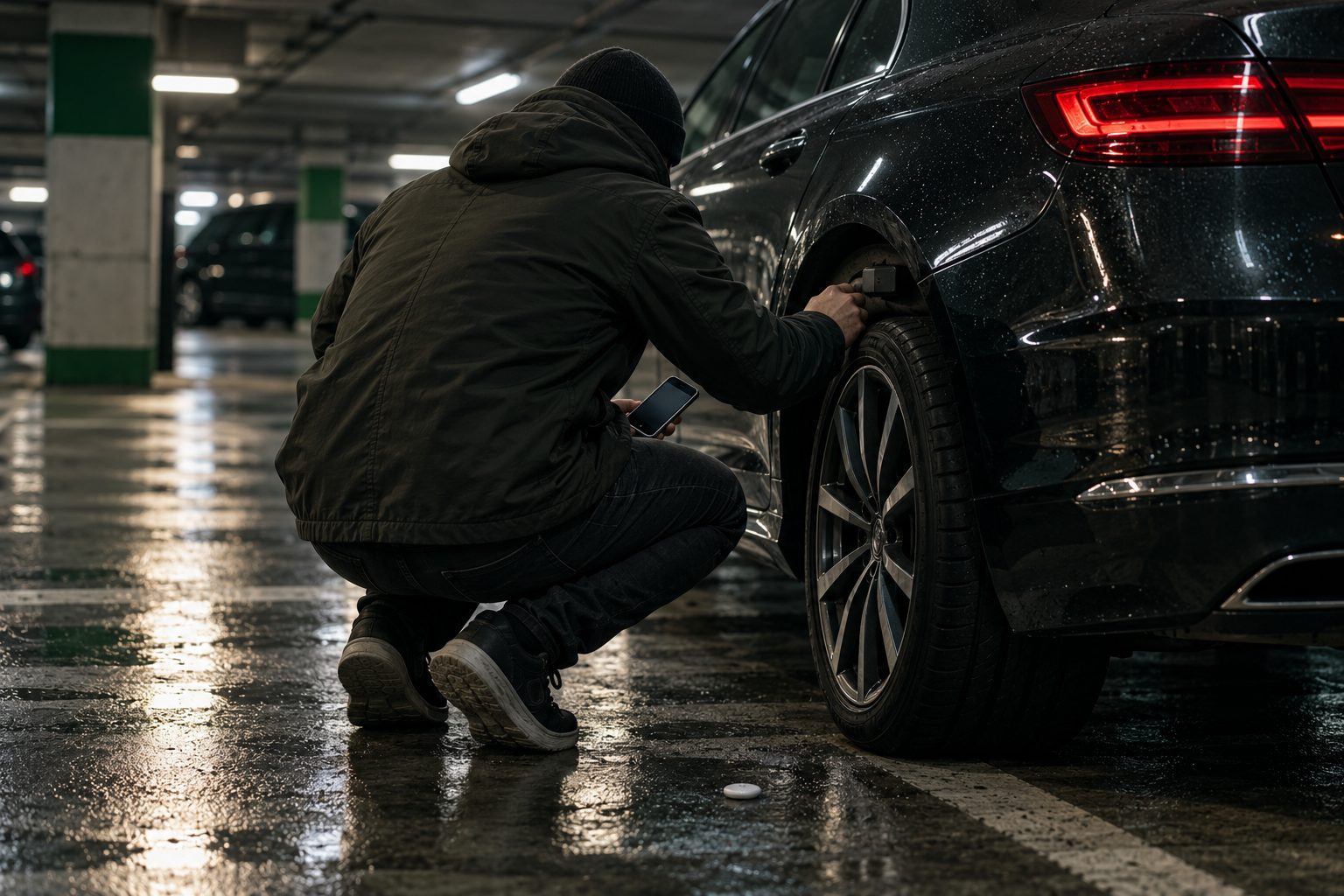
The quickest way to check whether someone is tracking you is to use your phone's built-in tracker alerts: iPhones warn when an unknown AirTag or compatible tracker is moving with you, and Android phones can run a manual scan for unknown trackers. This finds Bluetooth tags such as AirTags. It does not find GPS trackers with their own SIM card, which are commonly hidden on cars and need a physical search.
This guide explains the two kinds of tracker, how to check for each, where they are hidden on a car, and what to do if you find one.
Key facts
- Two kinds of tracker: Bluetooth tags (AirTag, Tile, SmartTag) report through nearby phones; GPS trackers use a SIM card and report directly over the mobile network
- iPhone: tracking notifications warn about unknown AirTags and compatible trackers moving with you (iOS 14.5 or later; iOS 17.5 or later for other makes)
- Android: automatic unknown-tracker alerts on Android 6.0 or later, plus a manual scan
- Phones do not detect SIM-based GPS trackers; finding those needs a physical and electronic search
- On a car: most trackers are magnetic units in wheel arches, behind bumpers, under the chassis, or plugged into the OBD port
- If you find one: do not remove it straight away; photograph it and get advice
Two kinds of tracker, two different checks
Bluetooth tags: AirTags and similar
AirTags, Tile, Samsung SmartTags and similar tags have no GPS or SIM. They send a Bluetooth signal that any nearby phone on the maker's network picks up and reports, so the owner sees the tag's location on a map. They are cheap, the size of a coin, and the battery lasts about a year. That makes them easy to drop into a bag, a coat or a car.
Because they rely on nearby phones, Apple and Google have built anti-stalking alerts into their phones, and agreed a shared standard so that compatible trackers from other makers also trigger alerts on both iPhone and Android.
GPS trackers with a SIM card
A GPS tracker works out its own position by satellite and sends it over the mobile network, like a phone. It does not depend on anyone else's phone, works anywhere with mobile coverage, and does not trigger phone tracker alerts. Battery units last weeks or months; wired units connected to the car's power never need charging. These are the trackers most often found on vehicles in disputes and investigations.
How to check for an AirTag or Bluetooth tracker
On an iPhone
Make sure Bluetooth, Location Services and Tracking Notifications are on and Airplane Mode is off. If an unknown AirTag or compatible tracker has been travelling with you, you will see an alert such as "AirTag Found Moving With You". Tap it to see a map of where it was detected with you, play a sound on the tag, and, on supported iPhones, use Precision Finding to locate it. You can also open the Find My app, go to Items and scroll to Unknown Items Detected with You.
On an Android phone
Android phones (version 6.0 or later) send automatic unknown tracker alerts. You can also run a manual scan from the unknown-tracker setting, usually under Safety & emergency. If a tracker is found, you can make it play a sound to find it.
Find the tag and identify it
Search your bag, coat pockets, car and anything you carry regularly. Holding an iPhone or NFC-capable phone near the white side of an AirTag shows its serial number and part of the owner's phone number, which is useful for police. Apple's guidance is that turning off Bluetooth or Location Services on your phone does not stop the owner seeing the tag's location; only disabling the tag does. Think about whether to disable it before you do: see "What to do if you find a tracker" below.
How to find a GPS tracker on your car
Phone alerts will not find a SIM-based GPS tracker, so a physical search is needed. Use a torch, and check these areas in order:
- Wheel arches: feel and look behind the plastic liners and on the metal above each wheel. Magnetic trackers are often here.
- Bumpers: look behind and under the front and rear bumpers.
- Underside and chassis rails: look along the flat metal under the car, especially near the edges.
- OBD port: the diagnostic socket, usually under the dashboard by the driver's knees. Check whether something unfamiliar is plugged in.
- Boot and spare-wheel well: lift the floor panel and check around the spare wheel and battery area.
- Cabin: under the seats, in seat pockets, in the glovebox and door pockets, and any charger plugged into a socket.
- Engine bay and wiring: look for unfamiliar boxes, new cable ties or wires spliced into the loom.
What does a tracker on a car look like?
Most are a small black or grey box, about the size of a matchbox to a deck of cards. Magnetic units often have a rubber or plastic case with a strong magnet on one face. Wired units have two or three wires running into the car's power supply. OBD trackers look like a small plug in the diagnostic socket. Some have a short stub aerial or a status LED.
Signs that something has been fitted include disturbed trim, fresh tool marks, new cable ties, wiring that does not match the rest, and clean patches on an otherwise dirty underside. See our case study: anatomy of a vehicle GPS tracker find.
Why a DIY search can miss a tracker
Trackers can be fitted inside panels, behind the dashboard or wired into the loom where they are not visible without removing trim. Some report only every few hours or store location data for later collection, so they are hard to catch electronically. A professional vehicle check combines a physical inspection with RF, cellular and non-linear junction detection, and typically takes one to two hours per car.
What to do if you find a tracker
- If you feel unsafe, go to a public place and contact the police.
- Do not remove or disable it straight away. Removing it tells whoever placed it that you know, and can destroy evidence that identifies them.
- Photograph it in place and note where it was and when you found it.
- Do not discuss it in the car or on a phone paired with the car.
- Get advice from the police, your lawyer or a TSCM specialist on how to handle it, and have your other vehicles and premises checked, because trackers are often found alongside other devices.
Read the full guide: found a listening device or GPS tracker? What to do first.
Is it legal to put a tracker on someone's car?
In the UK and most European countries, covertly tracking another person without a lawful basis can breach privacy, data-protection, harassment or stalking laws, and police take it seriously. The rules vary by country and situation, for example between a company tracking its own fleet with disclosure and a person tracking a partner, so take legal advice about any tracker you find.
When to bring in a professional
If you have found one tracker, suspect one that you cannot find, or are involved in a dispute, a business conflict or a high-profile role, a professional check is worth it. Vehicle checks are usually combined with a sweep of the home or office on the same visit. For planned work in Europe, a team-day typically costs €2,500–5,000 plus travel, and several vehicles can be checked in one day.
Bureau Securitas carries out vehicle tracker checks and TSCM sweeps across London and every EU capital. Contact us from a safe device at tscm@bureausecuritas.com. NDA on request.
Frequently asked questions
How do I know if someone is tracking me with an AirTag?
iPhones show an "AirTag Found Moving With You" alert when an unknown AirTag has been travelling with you, and Android phones send automatic unknown tracker alerts and can run a manual scan. You can then play a sound on the tag to find it.
Will my phone detect a GPS tracker on my car?
No. Phone alerts detect Bluetooth tags such as AirTags. GPS trackers with their own SIM card report over the mobile network and do not trigger phone alerts, so they need a physical and electronic search.
Where are trackers usually hidden on a car?
Most often in the wheel arches, behind the bumpers, on the chassis rails, in the OBD diagnostic port under the dashboard, in the boot or spare-wheel well, and under the seats.
What does a GPS tracker look like?
Usually a small black or grey box between the size of a matchbox and a deck of cards. Magnetic units have a strong magnet on one side; wired units have wires running into the car's power supply; OBD trackers look like a small plug in the diagnostic socket.
Should I remove a tracker if I find one?
Not straight away. Removing it alerts whoever placed it and can destroy evidence. If you feel unsafe, contact the police. Otherwise photograph it in place, avoid discussing it in the car, and get advice first.
Is it illegal to put a tracker on someone's car in the UK?
Covertly tracking another person without a lawful basis can breach privacy, data-protection, harassment or stalking laws in the UK and most European countries. The rules depend on the situation, so take legal advice about any tracker you find.