
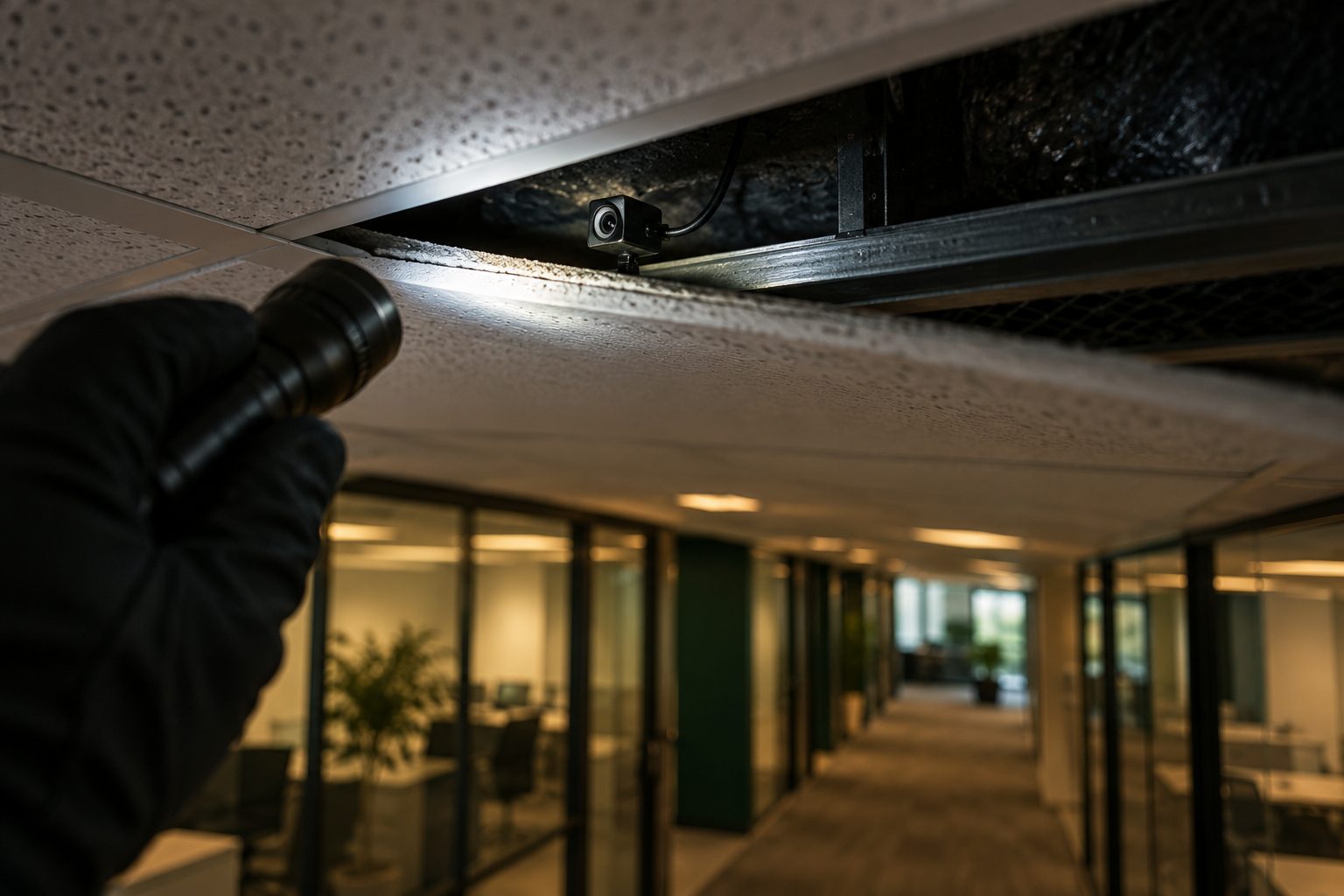
A hidden electronic camera was found in a ceiling panel at the government complex on Marsham Street, Westminster, which houses the Home Office, the Ministry of Housing, Communities and Local Government (MHCLG) and the Department for Environment, Food and Rural Affairs. As reported by ITV News in June 2026, the device was discovered during routine checks within the previous two months, and the security services were informed.
Home Office Minister Lord Hanson told the House of Lords that the camera was in a communal area of the MHCLG building, not near ministerial offices, and that the discovery did not point to foreign interference. MHCLG said it does not comment on security matters. The opposition called it a serious incident, and asked who placed the camera, how long it had been there and whether sensitive information was compromised.
Why this matters outside government
Government buildings have guards, passes and vetted staff. A camera still made it into a ceiling panel. If it can happen there, it can happen in a corporate headquarters, a law firm, a family office or a hotel.
Three points stand out.
1. It was found because someone was looking
The camera was found during routine checks. Without a schedule of checks, a device in a ceiling void can stay in place for months or years. Most organisations only look after a leak, by which time the damage is done.
2. Ceilings are a favourite hiding place
Ceiling tiles, light fittings, smoke detectors and vents give a camera a wide view and are rarely touched. In offices, cameras are typically aimed at screens, whiteboards and keyboards to capture documents and passwords. Our guide explains where hidden cameras are concealed and how to find them.
3. The hard questions come afterwards
Once a device is found, the key questions are the ones the opposition asked: who placed it, how long it had been there and what it captured. They can only be answered if the device is documented and preserved in place, not ripped out, and if you have records of earlier checks. Read what to do if you find a device.
Lessons for every organisation
- Check regularly, not only after a leak. Schedule sweeps of boardrooms, executive floors and other sensitive areas. A recurring programme also gives you a record of when each room was last checked.
- Include communal areas. Corridors, kitchens and shared meeting spaces see everyone pass through, and are easier to access than executive offices.
- Look up. Ceiling voids, smoke detectors and light fittings should be part of every check.
- Sweep after works. Building works, refurbishments and new AV installations give contractors access to ceilings and walls.
- Have a plan for a find. Decide in advance who is told, how the device is preserved, and when lawyers or police are involved.
How Bureau Securitas can help
Bureau Securitas carries out office and boardroom bug sweeps in London and every EU capital. Our two-person teams combine lens detection, RF spectrum analysis, non-linear junction detection, thermal imaging and a physical search of ceilings, fittings, furniture and equipment. Planned sweeps typically cost €2,500–5,000 per team-day plus travel, with a fixed written quotation first.
Contact us from a safe device at tscm@bureausecuritas.com. NDA on request.
*Sources: ITV News, June 2026; LocalGov, 10 June 2026.*
Frequently asked questions
Where was the hidden camera found in Westminster?
In a ceiling panel in a communal area of the MHCLG part of the government complex on Marsham Street, Westminster, which also houses the Home Office and DEFRA. It was reported in June 2026.
How was the camera discovered?
According to ITV News, it was found during routine checks, and the security services were informed.
Was the camera linked to foreign interference?
Home Office Minister Lord Hanson told the House of Lords that the discovery did not point to foreign interference, and that the camera was not near ministerial offices.
What should an organisation do if it finds a hidden camera?
Do not remove it. Photograph and document it in place, restrict knowledge of the find, and get advice from security specialists, lawyers and, where appropriate, the police. Then check related areas for other devices.